
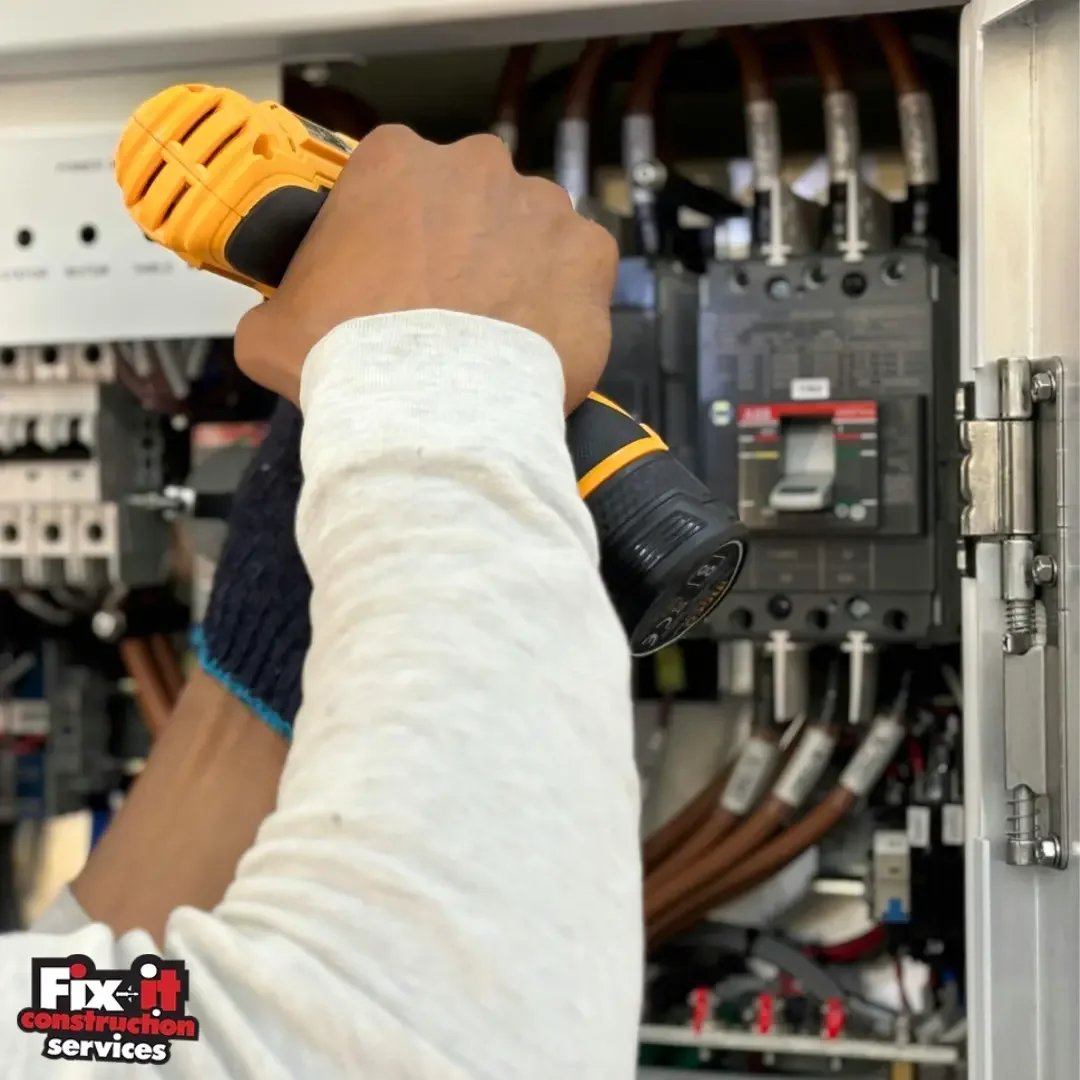
Technician using a cordless drill inside an electrical panel near a large circuit breaker, representing breaker and panel upgrade work by Fix-It Construction Services in Harrisonburg, VA
July in the Shenandoah Valley does not ease up. From Harrisonburg out through Rockingham County, Bridgewater, and Staunton, summer heat settles in and stays, and every household responds the same way: the air conditioning runs, the fans spin, the refrigerator works overtime, and the electric bill climbs. What most homeowners do not think about during this stretch is what all of that demand is doing to the electrical system running underneath it all. Summer is not just the season that strains your wallet. It is the season that strains your wiring, your outlets, your panel, and every protective device your home relies on to keep that load from becoming a hazard.
Why Summer Is the Hardest Season on a Home's Electrical System
Most residential electrical systems were designed around average daily demand, not the kind of sustained, simultaneous load a home carries during a mid-July heat wave. A central air conditioning unit running continuously draws a significant amount of current on its own. Add a refrigerator cycling more often because the kitchen is warmer than usual, multiple fans running throughout the house, a dehumidifier managing the region's humidity, and whatever else a household is running during a busy summer day, and a system that handles the rest of the year just fine can find itself operating near its capacity limit for hours at a stretch.
This sustained demand is different from the occasional spikes a system deals with the rest of the year. It is not one appliance kicking on briefly. It is multiple high draw appliances running simultaneously, hour after hour, day after day, throughout the hottest weeks of summer. Electrical components, including wiring, circuit breakers, and outlets, generate heat during use, and when ambient temperatures are already elevated by summer conditions, that heat has fewer ways to dissipate. This is part of why electrical problems cluster noticeably during summer rather than spreading evenly across the year.
How This Region's Climate Adds to the Challenge
Harrisonburg and the surrounding Shenandoah Valley experience real summer heat combined with meaningful humidity, and that combination matters for electrical systems in ways that go beyond simple temperature. Humidity accelerates corrosion on older wiring connections and outlet contacts, and it creates conditions where moisture can work its way into outdoor electrical components that were not designed to stay permanently sealed. The region also sits squarely in the path of summer storm systems that regularly produce lightning and the kind of grid level power fluctuations that travel directly into a home through its electrical connections.
What Surge Protection Actually Does and Why Summer Makes It Essential
Power surges are among the most misunderstood electrical threats homeowners face, partly because the most damaging ones happen in seconds and leave no obvious evidence until a device stops working.
The Two Types of Surges Worth Understanding
Most homeowners think of power surges as something that happens during a lightning strike, which is accurate but incomplete. Lightning related surges are dramatic and relatively rare. Internal surges, caused by large appliances like air conditioning compressors cycling on and off, happen constantly throughout a summer day and carry their own cumulative damage risk. Every time a compressor kicks on, it creates a brief voltage spike that travels through the home's wiring. Over a summer of constant cycling, these small, repeated spikes gradually degrade the sensitive electronics connected to the same circuits.
Why a Power Strip Is Not Surge Protection
One of the most common misconceptions in residential electrical safety is treating a power strip as a surge protector. Many power strips include no surge protection whatsoever, and those that do often carry protection ratings far below what a serious surge would deliver. Whole home surge protection, installed at the electrical panel, addresses both external surges from the grid and internal surges from large appliances at the point where they enter the home's wiring, rather than trying to catch them at individual outlets after they have already traveled through the system.
What Whole Home Protection Looks Like in Practice
A whole home surge protector installed at the panel works in combination with point of use protection at sensitive devices to create a layered approach. The panel level device handles the large surges, while point of use protectors manage residual energy that gets through. This combination is considerably more effective than relying on either approach alone, particularly during a summer storm season that regularly brings the kind of grid level disturbances common throughout the Shenandoah Valley region.
GFCI Protection and Why Summer Expands the Risk
Ground fault circuit interrupter protection exists to prevent one specific, serious hazard: electrical current finding a path to ground through a person rather than through the intended circuit. This risk increases significantly during summer simply because summer expands the range of ways people interact with electrical devices near water.
Where GFCI Protection Matters Most During Summer Months
Outdoor outlets see dramatically more use during summer, powering everything from string lights and fans on a porch to power tools used for yard projects and pressure washers for exterior cleaning. Each of these uses involves electricity in proximity to moisture, whether from rain, lawn irrigation, sweating hands, or the simple fact of working outdoors where conditions are less controlled than inside a home. A GFCI outlet detects the kind of imbalance in current flow that indicates a fault is occurring and cuts power in a fraction of a second, fast enough to prevent a serious injury in most scenarios.
When Existing GFCI Outlets Need to Be Checked
GFCI outlets and breakers do not last indefinitely, and they can fail in a way that is not immediately obvious. A GFCI device that has reached the end of its lifespan may still appear to function normally while no longer providing actual protection. The test and reset buttons built into every GFCI outlet exist specifically to allow periodic verification that the protection mechanism is still active, and a device that does not respond correctly to a test should be replaced rather than trusted. Given how much more outdoor and wet area electrical use happens during summer, verifying GFCI function before peak season is a reasonable precaution for any homeowner throughout this region.
GFCI Requirements and Older Homes in This Region
Many homes throughout Harrisonburg and surrounding Rockingham County communities were built before current GFCI requirements covered all the locations now mandated by electrical code. Older homes may have GFCI protection only in kitchens and bathrooms, or in some cases nowhere at all in outdoor circuits. Summer is when gaps in this coverage are most likely to create an actual hazard, since the same areas where GFCI protection is most critical, outdoors, near water features, and in garages and crawl spaces, are exactly where summer activity concentrates.
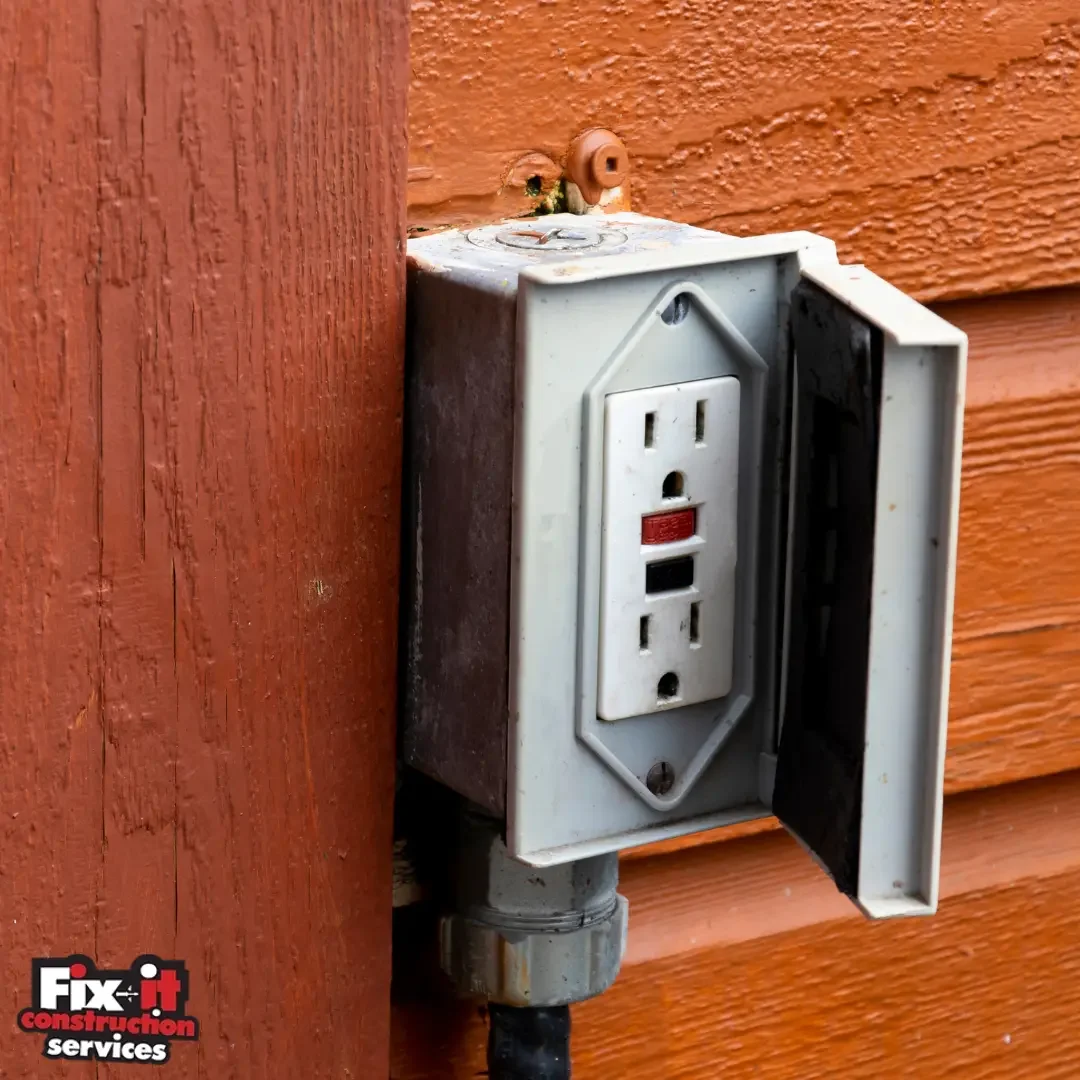
Aged outdoor GFCI outlet with weatherproof cover open on red wood siding, representing the outdoor GFCI inspection and replacement services Fix-It Construction Services provides across the Shenandoah Valley
AFCI Protection and the Hidden Hazard Most Homeowners Have Never Heard Of
While GFCI protection addresses ground faults involving people, arc fault circuit interrupter protection addresses a different and equally serious risk: arcing faults within the wiring itself that can ignite surrounding materials and start a fire without any obvious external warning.
What an Arc Fault Actually Is
An arc fault occurs when electrical current jumps across a gap in damaged, deteriorated, or improperly connected wiring. This jumping creates intense heat at a very localized point, often enough to ignite insulation, wood framing, or other combustible materials inside a wall long before any symptom appears on the surface. Unlike an overloaded circuit, which a standard breaker is designed to catch, an arc fault can occur at current levels well below what triggers a conventional breaker, meaning a home without AFCI protection has no automatic safeguard against this specific type of electrical fire.
Why Summer Conditions Increase Arc Fault Risk
The combination of sustained high electrical loads and elevated temperatures during a Shenandoah Valley summer creates conditions where arc faults are more likely to develop. Heat accelerates the breakdown of wire insulation, particularly in older wiring systems that have already been in service for decades. Connections that are slightly loose or corroded carry more resistance under sustained load, and that resistance generates heat that further degrades the connection over time. Homes that run air conditioning heavily throughout summer are cycling significant current through their wiring far more hours per day than they do during the rest of the year.
Where AFCI Protection Is Most Relevant
AFCI breakers are typically required in bedrooms and living spaces under current electrical code, since these are the areas where damaged wiring inside walls is most likely to go unnoticed longest before a fire starts. Older homes throughout this region that have not had their panels updated may lack AFCI protection entirely, relying on standard breakers that simply are not designed to catch this type of fault.
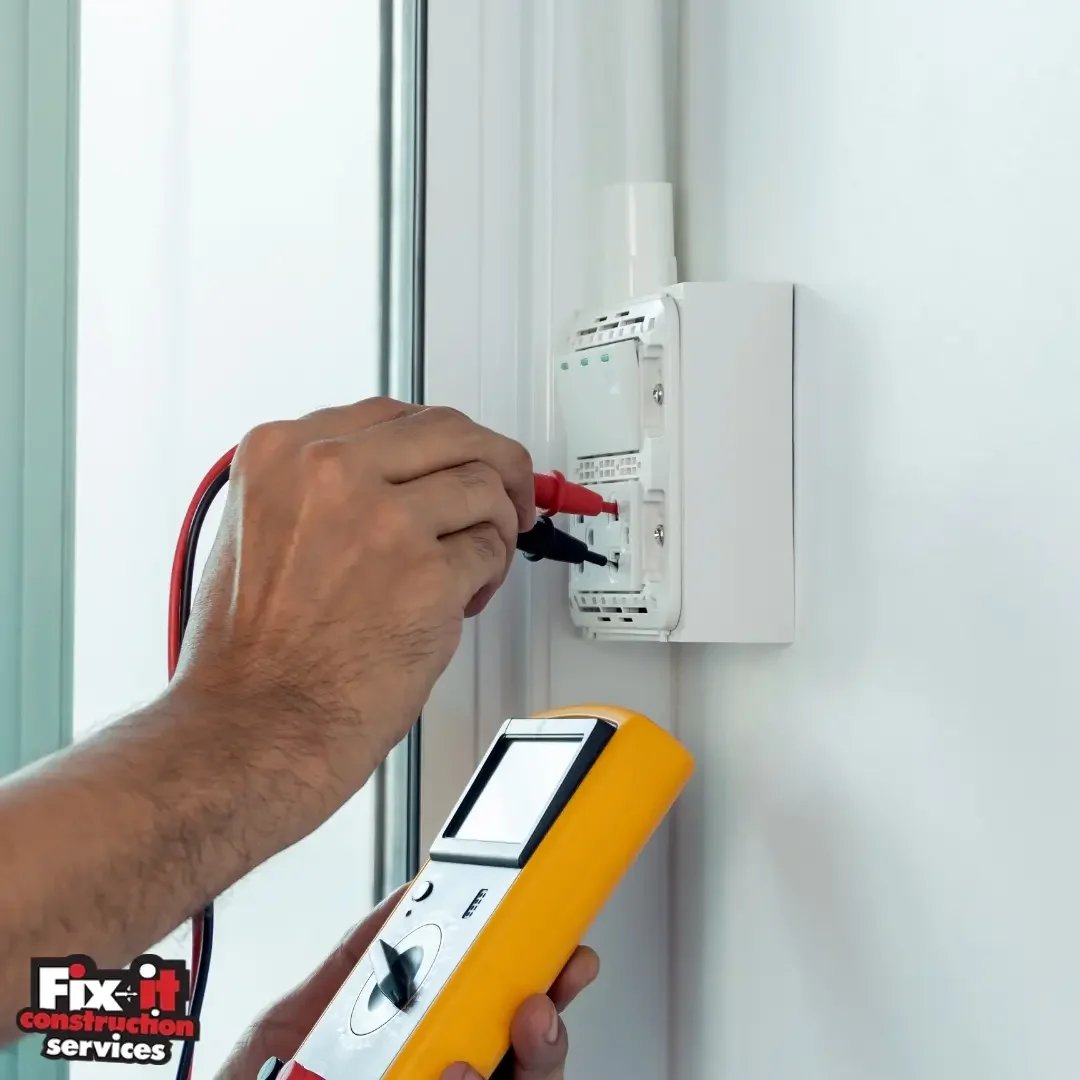
Technician using a yellow multimeter to test a wall-mounted electrical switch or smart device, representing electrical system assessment by Fix-It Construction Services in Harrisonburg, VA
Electrical Panel Capacity and Summer Demand
An electrical panel that was sized for the load a home carried when it was built may not be adequately sized for the same home decades later, particularly if large appliances like central air conditioning, a hot water heater, or an electric dryer have been added since the original installation.
Signs That a Panel May Be Reaching Its Limit
Breakers that trip repeatedly during summer, lights that dim noticeably when the air conditioning kicks on, and outlets that feel warm to the touch are all signs worth taking seriously rather than working around. These symptoms often point to a system operating near or beyond its comfortable capacity, and they tend to become most apparent during summer precisely because that is when demand is highest.
A Realistic Scenario
Consider a homeowner in Harrisonburg with a house built in the early 1990s. The home had its original panel, no whole home surge protection, and GFCI outlets only in the kitchen and master bathroom. Through most of the year, nothing seemed obviously wrong. Then a significant summer storm rolled through the valley, causing a brief power outage followed by a surge when service was restored. Two weeks later, the homeowner noticed the refrigerator was running louder than usual and the control panel on the HVAC system had become unresponsive. Neither failure happened during the storm itself, which made the connection easy to miss.
A licensed electrician found that the surge had damaged sensitive electronics in both appliances, damage that whole home surge protection at the panel would very likely have prevented. The same visit identified two outdoor outlets with GFCI devices that failed their test entirely, meaning they had not been providing actual protection despite appearing functional. Addressing all of it after the fact cost considerably more than addressing it proactively would have, and the appliance replacements were not recoverable costs at all.
Frequently Asked Questions
Does surge protection really make a difference for everyday appliances, or is it mainly for electronics? It matters for both. Refrigerators, HVAC control boards, washers, and dryers all contain sensitive electronics that are vulnerable to voltage spikes, and these are often the most expensive appliances to replace when surge damage occurs.
How do I know if my GFCI outlets are still working properly? Press the test button on each GFCI outlet. The power to that outlet should cut off immediately. If it does not, or if the reset button does not restore power correctly, the device needs to be replaced rather than relied on.
My breakers have never tripped. Does that mean my panel is fine? Not necessarily. A panel that is aging, undersized, or missing AFCI protection may not trip when it should, or may be operating at a level of load that is technically within its rating but creating heat and wear that shortens its lifespan and creates risk over time.
What is the difference between GFCI and AFCI protection? GFCI protection prevents electrocution by detecting faults involving a path through a person to ground. AFCI protection prevents electrical fires by detecting arcing faults within wiring itself. Both address different hazards and both are important, particularly in homes that have not been fully updated to current code.
Is whole home surge protection worth the cost? For most homeowners in this region, yes. A single significant surge event can damage multiple appliances simultaneously, with repair or replacement costs that can easily exceed the cost of whole home protection many times over.
Should I be concerned about electrical upgrades if my home seems to function normally? Normal function does not rule out the absence of surge protection, AFCI coverage, or aging GFCI devices. These issues do not typically announce themselves through obvious symptoms until something goes wrong.
Let Fix-It Construction Services Help You Stay Ahead of Summer Electrical Risks
Fix-It Construction Services works with homeowners across Harrisonburg and the surrounding Shenandoah Valley region to handle exactly these kinds of electrical needs, from whole home surge protection and GFCI verification to AFCI breaker upgrades and panel assessments. Licensed, bonded, and insured, with 24/7 emergency availability, our team is ready to make sure your electrical system is prepared for whatever this summer brings.
To schedule an estimate or talk through a specific concern, call Fix-It Construction Services at (540) 298-1776 or visit fixitrepairs.net to get started.
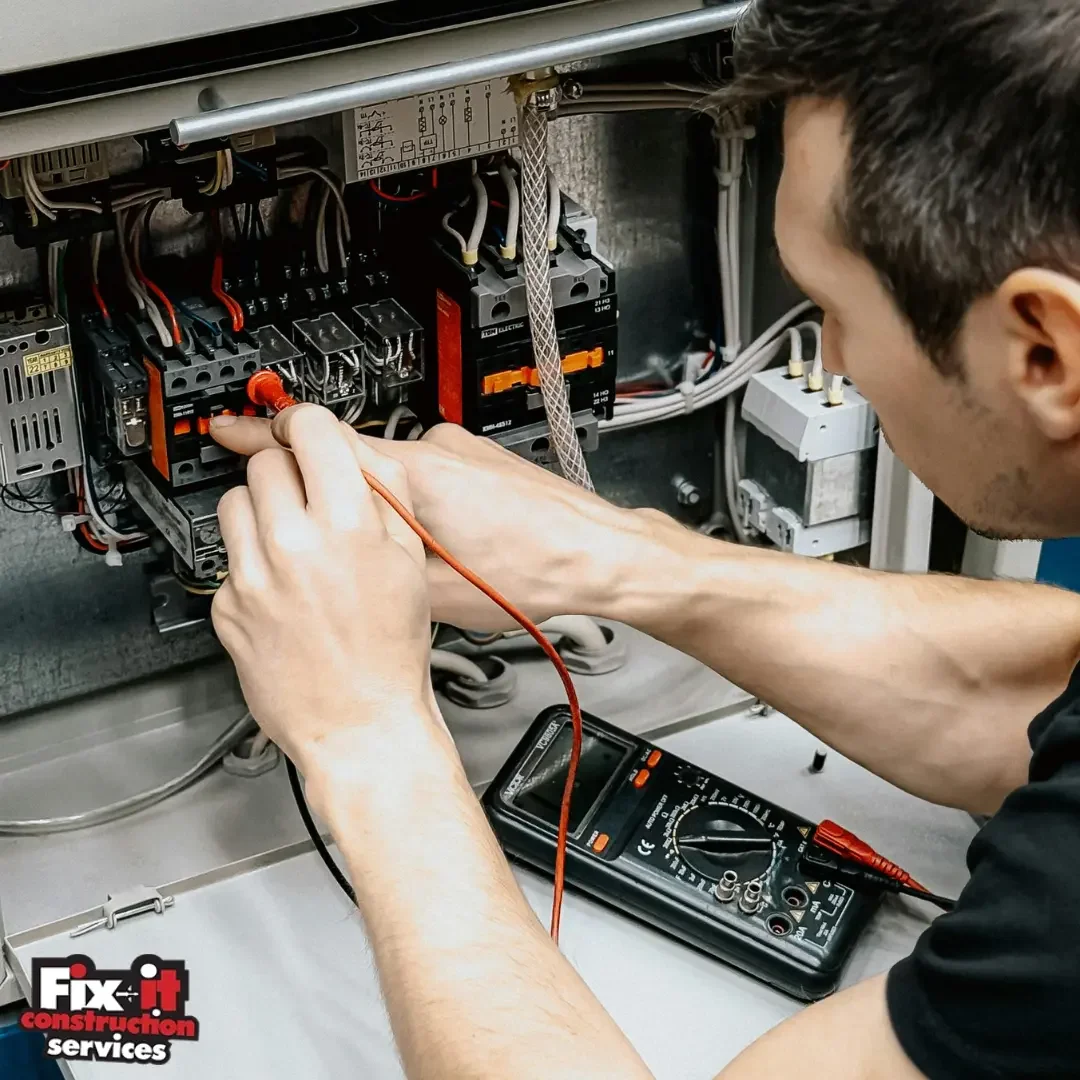
Electrician using a multimeter to test electrical connections inside a panel, representing the panel assessment services Fix-It Construction Services provides for Harrisonburg and Rockingham County homeowners
